The book
Buying a Business with an SBA Loan
How Much You Can Pay, What You Must Put Down, and What 1.6 Million SBA Loans Reveal About the Risk
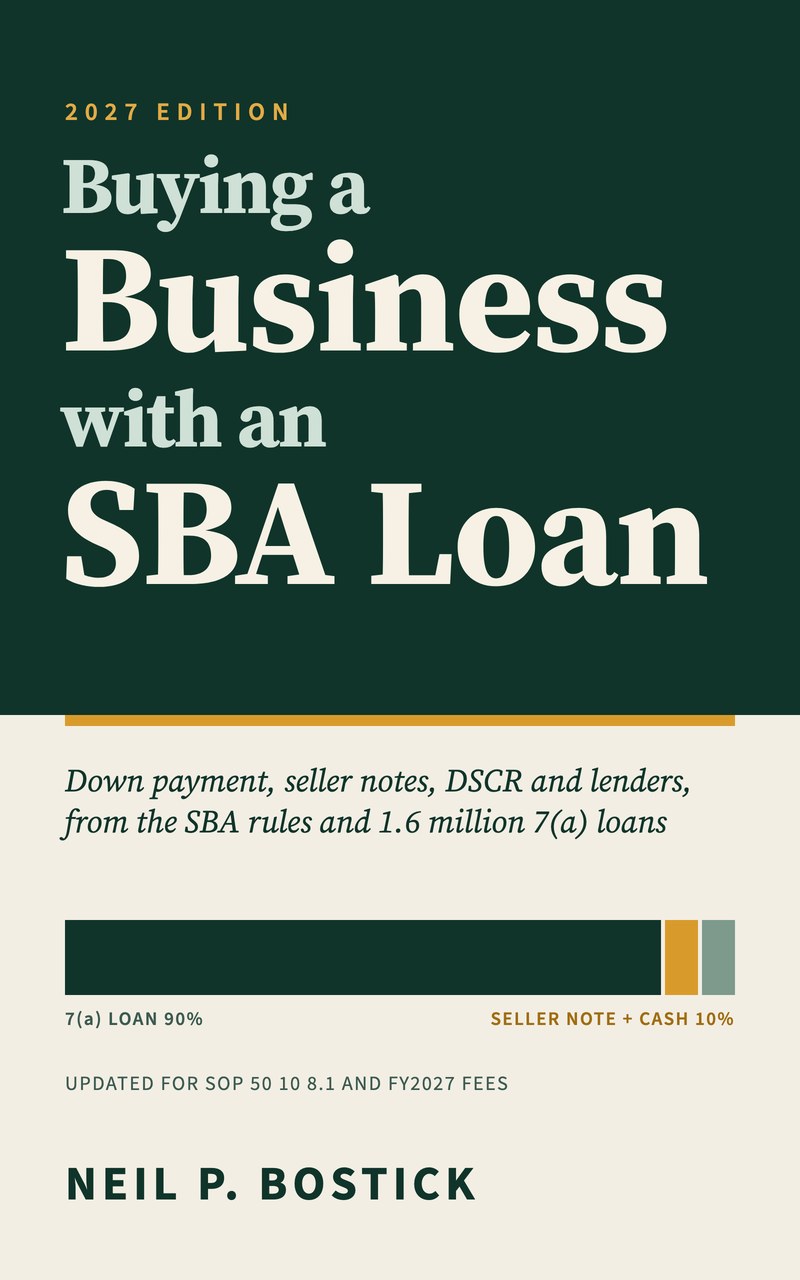
Neil P. Bostick · 232 pages · 15 figures
2027 Edition. Updated for SOP 50 10 8.1 (effective 1 October 2026) and the FY2027 fee notice.
List prices on Amazon.com when this page was last updated (4 October 2026). Amazon sets the price at checkout.
Disclosure. This site’s owner wrote the book and earns royalties from its sale. The Amazon links on this page are plain links, not affiliate links.
About the book
Most of what buyers read about SBA acquisition loans comes from people paid when a loan closes. This book shows the rules and the data instead. It reads SOP 50 10 8.1, the SBA's lending rules effective 1 October 2026, line by line, and it analyzes the SBA's own record of 1,624,422 7(a) loans approved from FY2000 to 30 June 2026, including 50,942 that lenders coded as a change of ownership. It covers the down payment and what can count toward it, seller notes and full standby, the debt service coverage math that sets the price a lender will finance, the personal guarantee and collateral, loss rates by vintage, industry, franchise and lender, and due diligence through the first year after closing. Every rule and figure is sourced in the notes, and contested claims are graded for strength of evidence. It is general information, not legal, tax or financial advice, and it recommends no lender, broker or advisor.
Five findings from the book
- There is no SBA route to "no money down" for a first acquisition. For an Initial Acquisition the minimum equity injection is 10% of total project cost, and the SOP says it "cannot be reduced or eliminated." A seller note on full standby can supply no more than half of it. (Chapter 7)
- The coverage test sets the price a lender will finance. At 1.25 coverage, a ten-year term and a 10% rate, each $100,000 of cash available for debt service supports about $504,000 of loan. (Chapter 5)
- When a loan was made predicts loss more than what it financed. 6.8% of standard-term loans approved in FY2010-2015 were eventually charged off, against 27.1% of those approved in FY2005-2008. (Chapter 11)
- Charge-offs arrive late. In the FY2010-2015 cohort, only one in eight eventual charge-offs (12.5%) had happened by the end of year three, so loss rates computed from young loans are too low. (Chapter 11)
- Comparing lenders by their median rates overstates the gap. Median rates from different years mix lender pricing with the prime rate. Held to one prime rate, the gap between the lowest- and highest-spread lenders shown is $316,581 on the book's illustrative worked deal, a little over half the naive figure. (Chapter 13)
Contents
- Introduction: The Loan Behind the Deal
Part One: The Loan
- 1. What an SBA Acquisition Loan Is
- 2. Who Can Borrow
- 3. The Price of the Money: Rates, Fees and Prepayment
Part Two: The Math
- 4. Earnings a Lender Will Believe
- 5. The Price Ceiling: Debt Service Coverage Math
- 6. The Valuation Gate
Part Three: The Structure
- 7. The Down Payment
- 8. Seller Notes, Standby and Earnouts
- 9. Partners, Investors and Partial Buyouts
- 10. The Guarantee and the Collateral
Part Four: The Risk
- 11. How Often These Loans Fail, and Where
- 12. Franchise Resales
Part Five: The Deal
- 13. Choosing a Lender
- 14. Due Diligence and the Road to Closing
- 15. After the Close: Living with the Debt
Back matter
- Appendix A: How the Data Was Analyzed
- Appendix B: Worksheets and Checklists
- Appendix C: The Rules at a Glance, and What Changed
- Glossary, Selected Sources, Notes, About the Author
232 pages, 15 figures. The free sample has the title pages, contents, the Introduction, Chapter 1 and the start of Chapter 2.
About the author
Neil P. Bostick founded FIH, a lower-middle-market M&A advisory, and runs FundingForBusinesses.com. He wrote this book because much of what buyers read about SBA acquisition loans comes from people paid when a loan closes, including people in his own line of work.
Disclosure. This site’s owner wrote the book and earns royalties from its sale. The Amazon links on this page are plain links, not affiliate links. Both of the author’s businesses can benefit when businesses are bought and financed; the book and this site recommend no lender, broker or advisor, his own included.
Corrections
None yet. Corrections to the 2027 Edition will be listed here with the date and the page affected. To report an error, use the contact page.
Questions
Is this book financial or legal advice?
No. It is general information about the SBA 7(a) program's rules and loan data. It does not predict whether any loan will be approved. Use your own attorney, CPA and lender for a specific deal.
Is the book endorsed by the SBA?
No. It quotes the SBA's rules and analyzes its public loan data, but the SBA has not reviewed or endorsed it.
Which rules does it cover?
SOP 50 10 8.1, effective 1 October 2026, with what changed from SOP 50 10 8 and 50 10 7.1, and the FY2025 to FY2027 fee notices. Lenders work from the version in force on the day a loan is approved.
Where does the data come from?
The SBA's public 7(a) FOIA loan-level files, with data as of 30 June 2026: 1,624,422 loans approved from FY2000. The tables and code are on the data page. Go to the data page.
Will it be updated?
Yes, yearly, because the SBA resets its fees every fiscal year and has replaced its main lending procedure three times since November 2023.
Does FundingForBusinesses.com arrange SBA loans?
No. This site is a publisher. It takes no applications and does not sell leads.
We are a publisher, not a lender or broker. We never take applications and are never paid by borrowers. Read the full disclosures.